

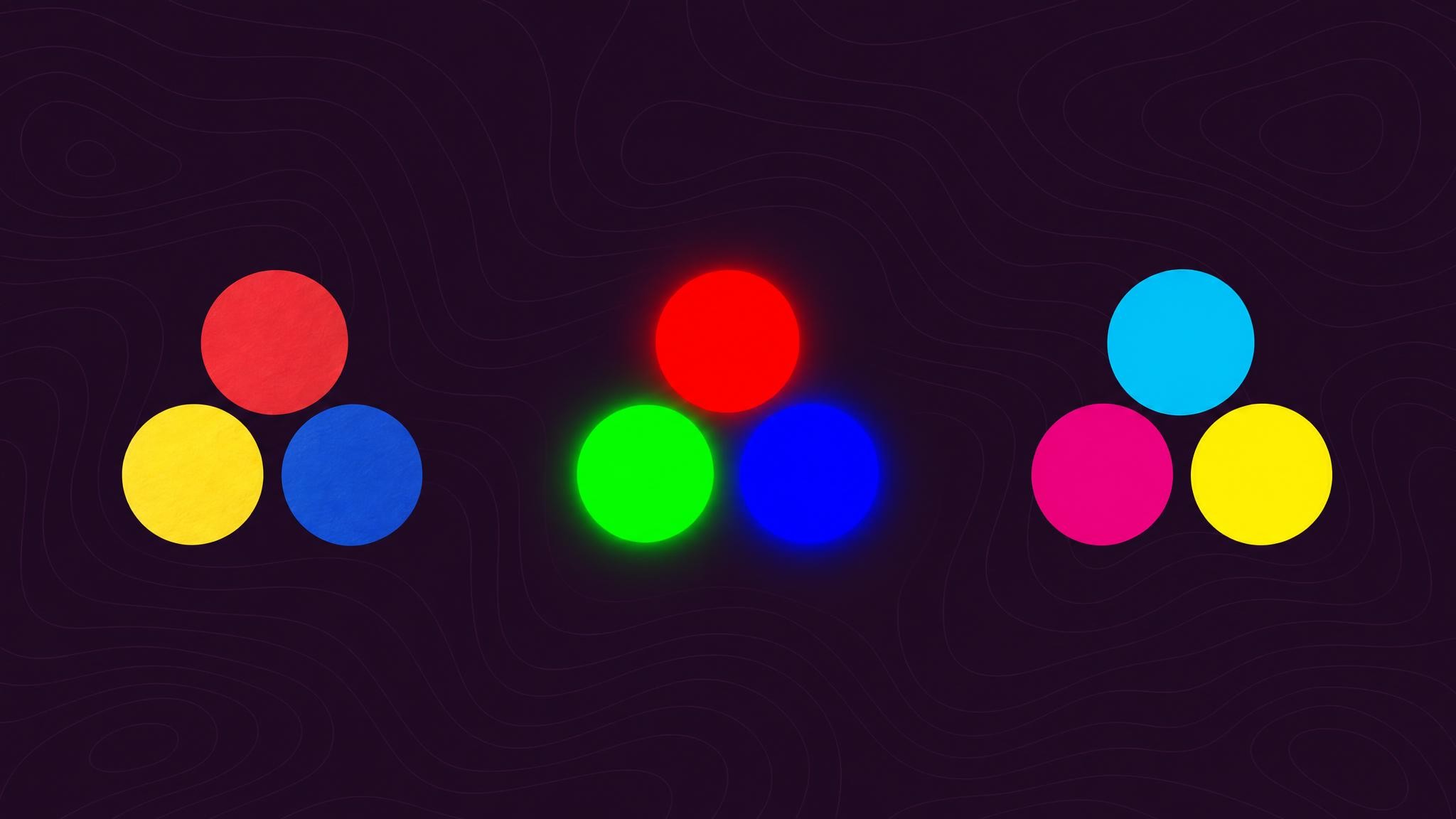
The primary colors are red, yellow, and blue if you’re mixing paint. On screens, they’re red, green, and blue. In printing, they’re cyan, magenta, and yellow. All three answers are correct, because each set belongs to a different way of mixing color.
So if your art teacher said red, yellow, and blue and a web developer says red, green, and blue, they’re both right. Which set you need depends on what you’re mixing: paint, pixels, or ink. Below you’ll find all three with hex codes, how each one mixes, and the secondary and tertiary colors they create.
The Quick Version
| Paint (RYB) | Light (RGB) | Print (CMY) | |
|---|---|---|---|
| Primary colors | Red, yellow, blue | Red, green, blue | Cyan, magenta, yellow |
| Used for | Painting, art class, crafts | Screens, web design, photos, video | Printers, magazines, packaging |
| How it mixes | Subtractive (pigment absorbs light) | Additive (light adds up) | Subtractive (ink absorbs light) |
| Secondary colors | Orange, green, purple | Yellow, cyan, magenta | Red, green, blue |
| All three mixed | A dark, muddy brown | White | Near black |
The split comes down to one difference. Paint and ink make color by absorbing light, while screens make color by adding light together. Change how the mixing works and the best set of starting colors changes with it.
What Are Primary Colors?
Primary colors are a small set of colors you can mix in different amounts to make a wide range of other colors. Three sets are in common use: RGB, CMY, and RYB. Each one fits a different medium.
There’s also no single official set. Wikipedia’s article on primary colors puts it plainly: there is “no one set of primaries that can be considered the canonical set.” Painters, printers, and screen makers each settled on the three colors that mix the widest range for their materials.
Even the best set has limits. No combination of real primaries can mix every color the human eye can see, so every screen and printer works within a limited range of colors called its gamut.
Why Are There Three Primary Colors?
The number three comes from your eyes. Most people have three types of cone cells, and each type responds most strongly to a different part of the spectrum. Short cones peak around 420 nanometers (nm), in blue-violet light. Medium cones peak around 530 nm (green), and long cones around 560 nm, which is yellow-green even though people often call them “red” cones.
Your brain builds every color you see by comparing those three signals. That’s why three well-chosen lights can recreate a huge range of colors.
Thomas Young proposed three types of color receptors in the early 1800s, and Hermann von Helmholtz built on his theory about 50 years later. In 1861, James Clerk Maxwell put the idea to work. He had photographer Thomas Sutton shoot a tartan ribbon three times, through red, green, and blue filters, then projected the three images together. It’s often called the first color photograph.
Red, Yellow, and Blue: The Primary Colors of Paint (RYB)
Red, yellow, and blue are the primary colors most of us learned in school, and they’re still the set most art classes start with. RYB is the oldest of the three models, and it’s easy to demonstrate with nothing more than a box of paints.
The history of RYB goes back centuries. Robert Boyle introduced the term “primary color” in English in 1664, though his list of five also included white and black. Jacob Christoph Le Blon printed with separate yellow, red, and blue plates (plus black), and in 1725 he called red, yellow, and blue the “primitive” colors. Moses Harris used the same term in 1766.
Paint mixes subtractively. Every pigment absorbs part of the light that hits it and reflects the rest, and the reflected light is the color you see.
Yellow paint absorbs blue and violet light and reflects red, yellow, and green. Blue paint absorbs red, orange, and yellow. Mix the two and the main light left over is green, so you see green.
Every paint you add absorbs a little more light, so mixes get darker as you go. Mix all three paint primaries together and you end up with brown.

Where RYB Falls Short
RYB is great for learning, but it can’t mix everything cleanly. Britannica points out that the CMY model produces a larger range of mixes than RYB. The more light two paints absorb between them, the darker and duller the result, and a typical red and blue absorb a lot. That’s why purples mixed from red and blue paint often come out muddy, a problem the purple mixing guide tackles head on.
If you paint, the usual fix is a split-primary palette, with a warm and a cool version of each primary. In a Jackson’s Art color mixing test, an orange-leaning red and phthalo blue gave browns instead of violet. Swapping in a bluish red (alizarin crimson) produced a rich violet, though it dulled the oranges. So reach for a cool red when you want purple and a warm red when you want orange.
Red, Green, and Blue: The Primary Colors of Light (RGB)
The screen you’re reading this on makes every color from red, green, and blue light. Each pixel is made of tiny red, green, and blue elements, and changing their brightness changes the color you see.
Light mixes additively. Each color you add brings more light, so mixes get brighter instead of darker. Equal amounts of red, green, and blue light make white, and turning all three off gives you black.
If you grew up mixing paint, this one feels wrong: red and green light make yellow. Your screen shows yellow by lighting its red and green elements and leaving blue off.

Hex codes are RGB values written in base 16. #FF0000 means red at full strength with green and blue switched off. The hex color codes guide explains how to read them, and the hex to RGB converter does the math for you.
| Color | Hex | RGB |
|---|---|---|
| Red | #FF0000 | 255, 0, 0 |
| Green | #00FF00 | 0, 255, 0 |
| Blue | #0000FF | 0, 0, 255 |
| All three (white) | #FFFFFF | 255, 255, 255 |
| None (black) | #000000 | 0, 0, 0 |
If you design for screens, I’d think in RGB from the start. Paint names like “red” and “blue” are fuzzy, while a hex code means one exact color.
Cyan, Magenta, and Yellow: The Primary Colors of Printing (CMY)
Printers use cyan, magenta, and yellow ink, plus black. That’s the CMYK you see in print settings, and the CMYK guide covers it in more depth.
Ink mixes subtractively, like paint. Each ink is designed to absorb one of the light primaries: cyan absorbs red, magenta absorbs green, and yellow absorbs blue. Whatever light isn’t absorbed bounces back off the paper as the color you see.
That makes CMY the mirror image of RGB. Overlap two inks and you get a light primary. Cyan and magenta make blue, magenta and yellow make red, and cyan and yellow make green.


These swatches show the ideal version. Real inks never hit these exact screen values, so printed mixes come out a little duller.
In theory, all three inks together make black. In practice, printers add a separate black ink (the K in CMYK), because it’s cheaper, faster, and less likely to cause visible defects than stacking three layers of ink.
Sending work to print? Run your screen colors through the hex to CMYK converter first, since bright RGB colors don’t always survive the trip to ink.
How the Three Sets Fit Together
RGB and CMY are two halves of one system. The secondary colors of light (cyan, magenta, and yellow) are the primary colors of ink, and the secondary colors of ink (red, green, and blue) are the primary colors of light.
RYB is the older, rougher cousin of CMY. The two often get mixed up because people assume cyan is just blue and magenta is just red. They’re close, but that gap is a big reason RYB mixes come out duller.
Can You Mix Primary Colors?
You’ll often hear that primary colors are “pure” and can’t be made from anything else. That’s only true inside one system. Step outside it and the rule breaks: magenta and yellow make red, and cyan and magenta make blue. Britannica calls the “pure primaries” idea a common misconception, and the guides to what colors make red and what colors make blue walk through both recipes.
The Yellow and Blue Test
Yellow and blue paint make green. Yellow and blue light make white, because yellow light is already red plus green, and adding blue completes the set.
You can see a version of this in the color mixer. Average yellow and blue in RGB mode and you get #808080, a plain gray. That’s white with every channel at half strength. The colors stayed the same, and only the mixing method changed.
Secondary Colors
Primary and secondary colors work as a pair: mix two primaries in equal amounts and you get a secondary. Each system has three of them.
| System | Mix | Secondary color |
|---|---|---|
| Paint (RYB) | Red + yellow | Orange |
| Paint (RYB) | Yellow + blue | Green |
| Paint (RYB) | Blue + red | Purple |
| Light (RGB) | Red + green | Yellow #FFFF00 |
| Light (RGB) | Green + blue | Cyan #00FFFF |
| Light (RGB) | Blue + red | Magenta #FF00FF |
| Print (CMY) | Cyan + magenta | Blue #0000FF |
| Print (CMY) | Magenta + yellow | Red #FF0000 |
| Print (CMY) | Yellow + cyan | Green #00FF00 |
Mixing the Paint Secondaries
In paint, the three secondaries are orange, green, and purple. The swatches below use screen colors to show each recipe, so expect real paint to land a little duller, especially purple.

Red and yellow make orange. More red pushes it toward red-orange, and more yellow pushes it toward gold. The what colors make orange guide covers shades like burnt orange and peach, or you can try red and yellow in the color mixer.

Yellow and blue make green. Use more yellow for a bright, limey green and more blue for a deeper, cooler one. See what colors make green for shades like sage, olive, and forest.

Red and blue make purple, and this is the mix most likely to turn muddy. A cool, blue-leaning red helps a lot. The what colors make purple guide covers the fix, and you can try red and blue in the color mixer.
Each secondary sits opposite the primary it doesn’t contain, which makes them complementary pairs: red and green, yellow and purple, blue and orange.
Tertiary Colors
Tertiary colors fill the gaps between the primaries and secondaries. Under the usual definition, you get one by mixing a primary with the secondary next to it on the color wheel, which gives six tertiary colors per system.
In paint (RYB), the six tertiary colors are:
- Red-orange
- Yellow-orange
- Yellow-green
- Blue-green
- Blue-purple, often called blue-violet
- Red-purple, often called red-violet
On screens and in print (RGB and CMY), they get their own names:
| Tertiary color | Mix | Hex |
|---|---|---|
| Orange | Red + yellow | #FF8000 |
| Chartreuse | Yellow + green | #80FF00 |
| Spring green | Green + cyan | #00FF80 |
| Azure | Cyan + blue | #0080FF |
| Violet | Blue + magenta | #8000FF |
| Rose | Magenta + red | #FF0080 |
There’s also an older definition you’ll run into in art books. It treats tertiaries as mixes of two secondaries, which gives three muted colors traditionally called russet (orange and purple), slate (purple and green), and citron (green and orange).
Put the 3 primaries, 3 secondaries, and 6 tertiaries together and you have the classic 12-color wheel. The color wheel guide shows how to build color schemes from it.
Using Primary Colors in Design
A primary color palette (red, yellow, and blue together) is a triadic color scheme, since the three sit evenly spaced around the wheel. The combination reads as bold, playful, and a little retro. Piet Mondrian’s grid paintings, with blocks of red, yellow, and blue between black lines, are a classic example. To build around one of the three, browse the red, yellow, and blue color palettes.
A few tips for working with them:
- Let one primary lead and use the other two as accents. Three equally loud colors fight for attention.
- Pull back the saturation. Pure
#FF0000,#FFFF00, and#0000FFare harsh on screens, and softened versions feel more modern. The color shades generator gives you tints and shades of any primary. - Watch your contrast. Yellow text on white has a contrast ratio of about 1.07:1, while WCAG asks for at least 4.5:1 for normal text. Pair yellow with dark colors and test the combo in the contrast checker.
- Start from a palette instead of a blank canvas. The color palette generator gives you full palettes to remix, and the color picker shows the harmonies for any single color.
Frequently Asked Questions
What are the 3 primary colors?
It depends on the medium. For paint, they’re red, yellow, and blue. For light and screens, they’re red, green, and blue. For printing, they’re cyan, magenta, and yellow.
How many primary colors are there?
Each color model uses three. Across paint, light, and print, that adds up to six different colors: red, yellow, blue, green, cyan, and magenta.
Is yellow a primary color?
Yes in paint (RYB) and printing (CMY). No on screens, where yellow is a secondary color made from red and green light. The what colors make yellow guide covers both.
Is green a primary color?
Only in light. Green is a primary in RGB, but in paint it’s a secondary made from yellow and blue, and in printing it comes from cyan and yellow.
Is blue a primary color?
Yes, in both paint (RYB) and light (RGB). Printers make blue by overlapping cyan and magenta ink.
Is red a primary color?
Yes, in paint and on screens. In printing, red comes from overlapping magenta and yellow ink.
Is magenta a primary color?
Yes in printing, where magenta is one of the three CMY inks. On screens, magenta is a secondary color made from red and blue light.
Is orange a primary color?
No. Orange is a secondary color in paint, made from red and yellow. On screens, it’s a tertiary color that sits between red and yellow.
Are white and black primary colors?
No. White light contains every color (Isaac Newton showed this by splitting white light with a prism), and black is the absence of light. Printers add black ink for practical reasons, and painters use white and black to lighten and darken colors, but neither one is a primary.
Are there four primary colors?
In color science, sometimes. Ewald Hering proposed four “psychological primaries” (red, green, yellow, and blue) arranged as opposite pairs, with red against green and yellow against blue. For mixing paint, light, or ink, three primaries per system is still the standard.
What are the seven main colors?
Those are the colors of the rainbow. Isaac Newton listed red, orange, yellow, green, blue, indigo, and violet in his 1704 book Opticks. They describe the visible spectrum rather than a set of primaries.
What are the real primary colors?
For light, red, green, and blue line up with the three cone types in your eyes. For paint and ink, cyan, magenta, and yellow mix a wider range than red, yellow, and blue. RYB is the traditional set, and it’s still a fine way to learn color mixing.
Putting It Into Practice
Match the primaries to your medium: RYB for paint, RGB for anything on a screen, and CMY for print. If you design digitally, work in RGB and hex, then check your colors before anything goes to a printer.
To see the mixes for yourself, plug any two colors into the color mixer. For the bigger picture of how primaries, secondaries, and tertiaries fit together, the color wheel guide is the next stop. And if you want to try all three paint primaries at once, mixing brown is the classic test.