


Whether you’re an artist, designer, or just curious about how colors work in printing, knowing the ins and outs of CMYK can make all the difference. In this post we’ll go over what CMYK means, what it’s used for, and why it’s important for printing.
Have you ever wondered why the colors on screen often look different when they’re printed? This discrepancy boils down to the different color models used in digital versus print media. The CMYK color model is key to color printing, used extensively to ensure accurate color reproduction in physical media. But what exactly is CMYK?
What Does CMYK Stand For?
CMYK refers to Cyan, Magenta, Yellow, and Key (Black). These are the primary colors used in the subtractive color model for color printing. Unlike the RGB (Red, Green, Blue) color model used for digital screens, CMYK is designed for inks and pigments.

In CMYK, colors are created by subtracting light from white, hence the term “subtractive color model.”
Understanding the Subtractive Color Model
How CMYK Works
In the CMYK system, colors start with a white background, and adding each color ink reduces the light that reaches our eyes. The CMYK system uses four ink plates: cyan, magenta, yellow, and black, to create a wide range of colors. When combined, these four inks can produce a gamut of colors.
For instance:
- Cyan and Yellow create Green.
- Magenta and Yellow create Red.
- Cyan and Magenta create Blue.
Black ink (Key) is added to deepen the colors and add detail, as mixing all three colors (Cyan, Magenta, and Yellow) typically results in a muddy brown rather than pure black.
The Differences Between RGB and CMYK
Color Models and Their Applications
The RGB color model, which stands for Red, Green, Blue, is an additive color model used in digital screens. It works by adding light to a black background to create colors. When all colors are combined at full intensity, they produce white light.
The RGB color space is essential for web design and digital displays, providing a wide range of colors for screens.
Comparatively, the CMYK model subtracts from a white background and is designed for ink and pigment-based applications like printing. That’s why colors displayed on a screen (RGB) often appear brighter and more vibrant than printed colors (CMYK). If you have a hex code from a digital design, our hex to CMYK converter shows its closest print equivalent.
How CMYK is Used in the Printing Process
Halftone and Full-color Printing
When printers use the CMYK model, they typically print tiny dots of each color in varying intensities to create the final image. This technique is known as halftone printing. By using small dots of different sizes and spacing, printers can produce a wide range of colors and shades.
The black plate is called the key plate because the other color plates are traditionally keyed (aligned) to it, and it carries most of a print’s fine detail.
Offset Printing and inkjet printers utilize CMYK to deliver high-quality, full-color prints. This process is common in everything from posters to packaging.

The Importance of CMYK in Design
Color Accuracy and Matching
When you’re working on a design that will eventually be printed, it’s important to use the CMYK color mode in design software like Adobe Photoshop or Illustrator. This approach helps ensure that the colors you see on your computer screen closely match the final printed piece when CMYK printing.
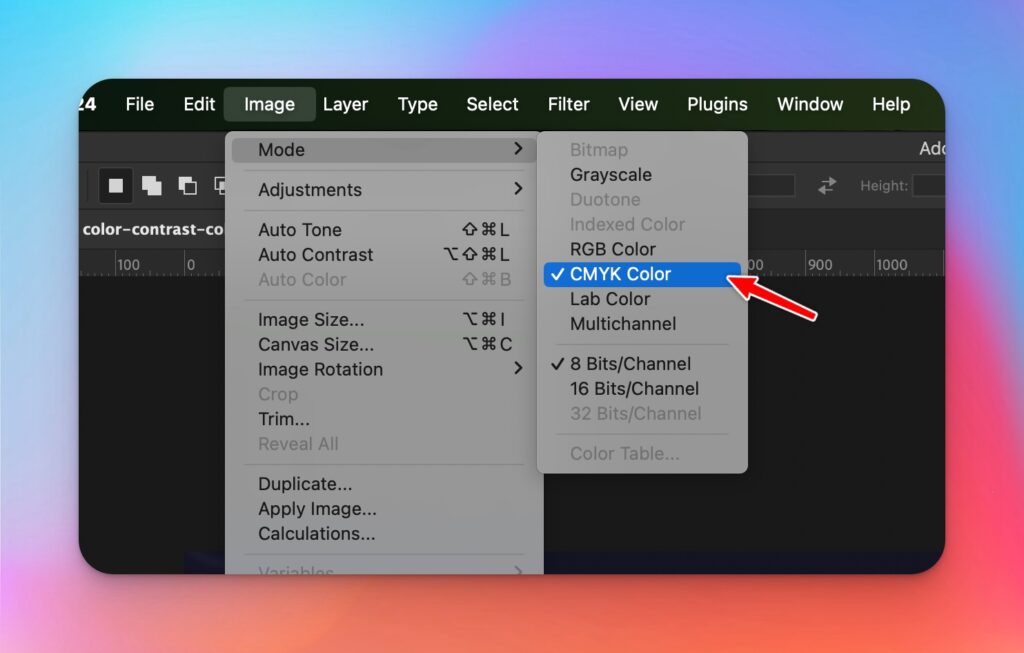
Designers aiming for precise color reproduction often rely on CMYK combined with Pantone (PMS) spot colors. This practice guarantees consistent, exact colors that are essential for maintaining your brand’s integrity.
Industry Standards and Applications
High-quality and Industry-standard Printing
In the printing industry, CMYK (Cyan, Magenta, Yellow, and Key (Black)) is the standard for high-quality color printing. It’s essential for precise color matching, making it ideal for branding materials, brochures, and packaging.
Using solid black, which involves 100% black ink, is essential for achieving deep and uniform shades in print production.
Why Use CMYK in Printing?
CMYK printing uses colored inks to produce a wide range of hues, making it versatile for various print needs.
- Cost-Efficiency: Economical for full-color prints due to compatibility with standard printers.
- Versatility: Produces a wide range of colors suitable for various print needs.
- Efficiency: Works with standard CMYK cartridges in most printers.
Spot Colors and Pantone
For exact color matching, Spot Colors like Pantone are used. These pre-mixed inks ensure uniformity, particularly important for brand colors.
Different color systems, such as CMYK and Pantone, offer unique advantages for achieving precise color matching in print.
Key Considerations
- Color Accuracy: Calibration and proofing are vital to match intended colors.
- Paper Type: Affects color appearance; glossy for vibrant colors, matte for subdued tones.
- Resolution: High resolution is essential for clear, sharp images and text.
By using CMYK and Spot Colors appropriately, you can achieve professional, consistent print results.
Conclusion
Understanding CMYK means more than knowing what the acronym stands for: it means knowing how the subtractive model behaves on paper, so your printed materials appear as intended.
Design in CMYK from the start and your work will look as good in print as it does on screen. Whether you’re designing for your brand or creating art, CMYK is the backbone of color printing, and your colors will come out the way you planned.