

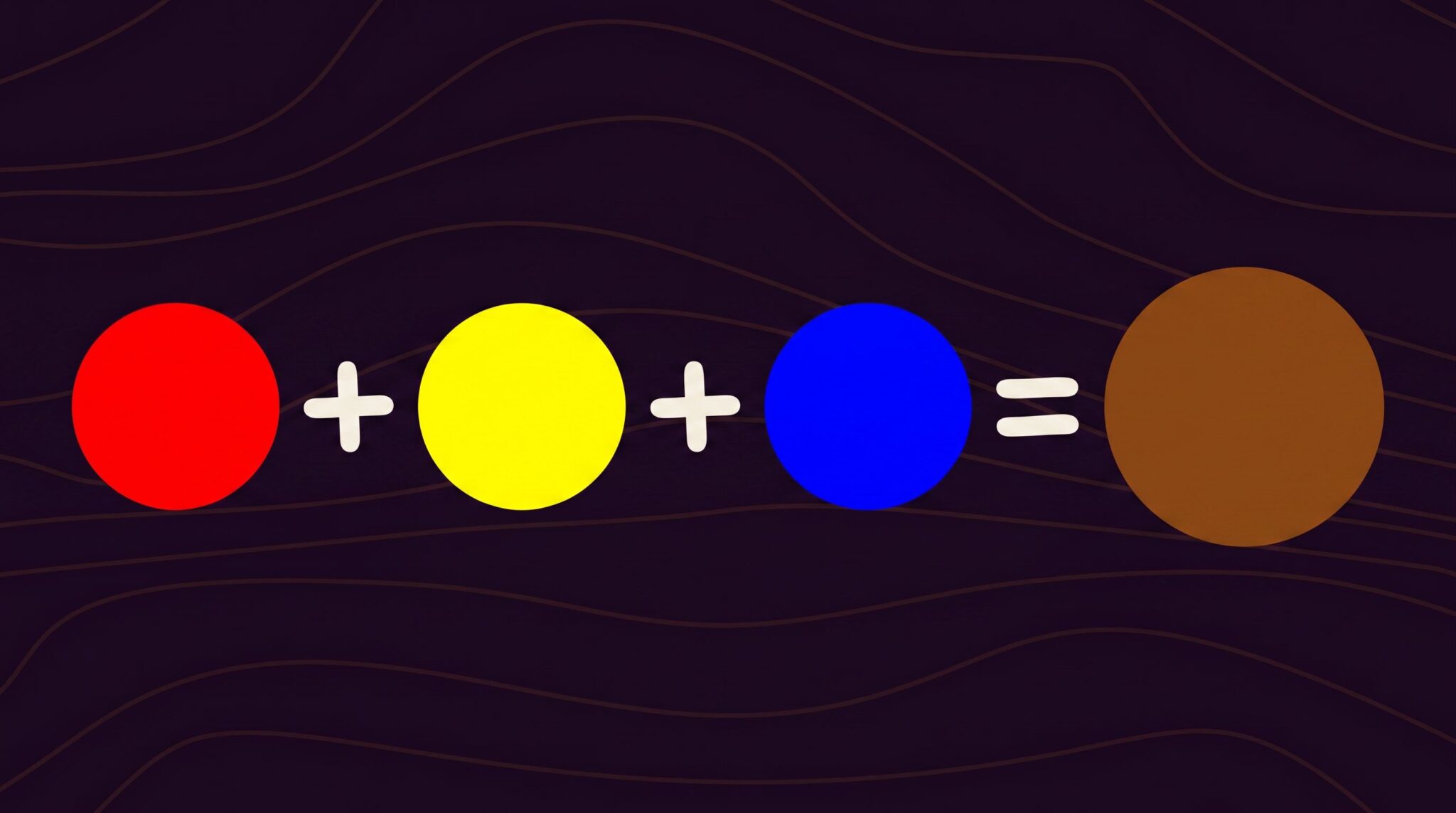
Brown is made by mixing all three primary colors (red, yellow, and blue) together, or by combining any two complementary colors on the color wheel: red and green, yellow and purple, or orange and blue. The exact shade of brown depends on which combination you use and the proportions of each color. Adjust by adding white to lighten or black to darken.
The Short Answer
Brown is a tertiary color, meaning it forms when you mix multiple colors together. The two standard recipes are: red plus green (the easiest and cleanest) or red plus yellow plus blue (all three primaries together). Both produce brown because the colors cancel out their complementary opposites. From a base brown, you can shift toward warmer tones by adding more red or yellow, cooler tones by adding more blue, lighter tones by adding white, or darker tones by adding black or burnt umber.
Brown sits between primary and tertiary territory. Some color systems treat it as a tertiary, others as a “neutral” alongside black, white, and gray. For the practical purpose of mixing it on a palette, what matters is the recipe.
What Colors Make Brown?
There are several valid ways to mix brown, and each produces a slightly different result. Pick the recipe based on what you have on your palette and the temperature of brown you want.
Recipe 1: Red + Green
The cleanest, most reliable way. Red and green are complementary colors (opposite on the color wheel), so mixing them cancels their saturation and lands in neutral brown territory. Use cadmium red plus phthalo green or sap green for a clean, balanced brown. Adjust the ratio: more red gives warmer reddish-brown (sienna), more green gives cooler olive-brown.
Recipe 2: Yellow + Purple
Another complementary pair. Mix cadmium yellow with a purple (made from red plus blue, or straight from a tube) to produce a slightly warmer, more golden brown. This recipe leans toward ochre and yellow-brown. Useful for autumnal palettes and earthy tones.
Recipe 3: Orange + Blue
Third complementary pair. Mix cadmium orange (or red plus yellow) with ultramarine blue. The result tends toward a deeper, more olive-leaning brown. This is the recipe to use if you started with orange and need to mute it. Add the blue in tiny amounts since it shifts orange dramatically.
Recipe 4: All Three Primaries
Mix red, yellow, and blue together in roughly equal parts and you get brown. This is the recipe most kids learn in elementary school art class. It works because all three primaries together cancel each other’s complements simultaneously. The result is a balanced, slightly muddy brown that’s a good neutral starting point.
Whichever recipe you pick, brown is the result of canceling saturation. There’s no clean way to get brown without combining at least two complementary forces.
How to Make Brown (Step-by-Step)
The simplest, most reliable approach uses the red-plus-green recipe. The basic process:
- Pick your red. Cadmium red is the standard. Alizarin crimson works for cooler, more burgundy-leaning browns.
- Pick your green. Phthalo green for a clean, cool starting point. Sap green for a warmer, more earthy result. Avoid premixed greens that already contain yellow, since they’ll skew the brown.
- Start with equal parts. A 1:1 ratio of red and green gives you a balanced, mid-tone brown. From there you adjust.
- Push warmer with more red. Add red in small increments to shift toward sienna, mahogany, and chestnut.
- Push cooler with more green. Add green to shift toward olive-brown and umber. Be cautious: a little green pulls the color a long way.
- Lighten with white or yellow. White produces tints (tan, beige, cream-brown). Yellow shifts toward ochre and caramel without losing warmth.
- Darken with black or more pigment. Black darkens cleanly. Adding more red plus more green at a darker ratio produces a richer, more saturated dark brown.
- Test on a swatch before committing. Brown looks different next to other colors than it does in isolation. Mix small, swatch it next to your target color, decide.
On screen, brown is a tertiary RGB color. A standard brown like saddle brown is #8B4513. Mid-brown sits around #A0522D. The HSL hue value for most browns falls between 15° and 35° (the warm half of the wheel) with low saturation and mid-low lightness. To shift digital brown: raise the red channel for warmer brown, raise the green channel for olive-brown, lower the blue channel for richer brown.
Mixing Different Shades of Brown
Once you have a base brown, you can reach nearly every brown-adjacent hue by adjusting which primaries you started with, plus small additions of white, yellow, or black. Each shade below has a recipe you can mix today, plus the closest hex code if you need to match it digitally.
How to Make Dark Brown
Dark brown is a deep, rich brown without going to pure black. Mix dark brown by combining cadmium red with phthalo green plus a small amount of black, in roughly 2:2:1 ratio. For a warmer dark brown, use burnt umber instead of black. Common in luxury, leather, and editorial palettes.

How to Make Light Brown
Light brown is the broad family of softer, paler browns. The simplest recipe is any base brown plus white, with the ratio depending on how light you want to go. For a warmer light brown, add a small amount of yellow ochre. The closest hex code for a generic light brown is #B5651D.

How to Make Chocolate Brown
Chocolate brown is a warm, rich, slightly red-leaning brown. Mix chocolate brown by combining cadmium red with phthalo green in roughly a 3:1 ratio, then a small amount of burnt umber to deepen and warm. For a darker chocolate, add a tiny touch of black. Common in food packaging, hospitality, and fall-leaning palettes.

How to Make Chestnut
Chestnut is a reddish-brown with warm, slightly orange undertones. Mix chestnut by combining cadmium red with cadmium orange and a small amount of phthalo green, in roughly 3:1:1 ratio. For a deeper chestnut, add a touch of burnt umber. Used in equestrian, traditional, and earthy palettes.

How to Make Coffee Brown
Coffee brown is a warm, slightly muted mid-brown. Mix coffee by combining cadmium red with sap green plus a small amount of yellow ochre, in roughly 2:2:1 ratio. The result is rich and earthy without going too dark. Common in cafe branding, lifestyle, and warm-neutral palettes.

How to Make Tan
Tan is a soft, light brown with strong yellow undertones. Mix tan by combining a basic brown (red + green) with a generous amount of white and a small amount of yellow ochre, in roughly 1:4:1 ratio. For a cooler tan, reduce the ochre. Used in fashion, hospitality, and earthy minimal palettes.

How to Make Beige
Beige is a very light, slightly yellow-warm cream-brown. Mix beige by combining a small amount of yellow ochre with a generous amount of white, plus a tiny touch of brown to anchor the warmth. The ratio is roughly 1:8:0.5. Common in interior design, fashion, and minimalist branding.

How to Make Sienna
Sienna is a warm, reddish-brown named after the Italian city. Mix sienna by combining cadmium red with cadmium yellow plus a small amount of phthalo green, in roughly 2:1:1 ratio. For burnt sienna (a more saturated cousin), add a touch of orange. Sienna is one of the most-used earth tones in classical painting.

How to Make Burnt Sienna
Burnt sienna is a vibrant, orange-leaning red-brown. While sienna can be mixed, burnt sienna pigment (made from heating sienna ore) has a unique luminosity hard to replicate. To approximate, combine cadmium red with cadmium orange plus a small amount of burnt umber, in roughly 2:2:1 ratio. Common in figurative painting and warm earth-tone palettes.

How to Make Burnt Umber
Burnt umber is a deep, slightly red-leaning dark brown. While burnt umber is itself a pigment, you can approximate it by combining cadmium red with phthalo green plus a generous amount of black, in roughly 2:2:1.5 ratio. The result is one of the most useful dark browns in any palette: not too warm, not too cool.

How to Make Khaki
Khaki is a muted, slightly green-yellow tan. Mix khaki by combining a basic brown with cadmium yellow plus a small amount of phthalo green and a generous amount of white, in roughly 1:1:0.5:3 ratio. The green pushes khaki toward its olive character. Used in military, outdoor, and utilitarian palettes.

How to Make Caramel
Caramel is a warm, golden-brown with sweet undertones. Mix caramel by combining cadmium red with cadmium yellow plus a small amount of burnt umber, in roughly 1:2:1 ratio, then a small amount of white to lighten. Common in food, hospitality, and warm-neutral branding.

How to Make Taupe
Taupe is a muted, slightly cool dark gray-brown. Mix taupe by combining a basic brown with a small amount of black and a touch of gray, in roughly 3:1:1 ratio. For a warmer taupe, add a tiny touch of yellow ochre. Common in interior design, fashion, and sophisticated minimalist palettes.

How to Make Mahogany
Mahogany (in its deepest furniture-grade form) is a very dark, slightly red brown. Mix mahogany by combining alizarin crimson with phthalo green plus a generous amount of black, in roughly 3:1:1 ratio. The crimson keeps the red character while the green and black darken without graying. Used in traditional furniture, leather, and heritage design.

Quick Reference: Brown Mixing Cheat Sheet
Every brown shade above in one extractable table. Save it, copy it, paste it wherever you need it.
| Shade | Hex | Mixing Recipe |
|---|---|---|
| Dark Brown | #5D4037 | Cadmium Red + Phthalo Green + Black (2:2:1) |
| Light Brown | #B5651D | Base Brown + White + small Yellow Ochre |
| Chocolate | #7B3F00 | Cadmium Red + Phthalo Green (3:1) + small Burnt Umber |
| Chestnut | #954535 | Cadmium Red + Orange + small Phthalo Green (3:1:1) |
| Coffee | #6F4E37 | Cadmium Red + Sap Green + small Yellow Ochre (2:2:1) |
| Tan | #D2B48C | Base Brown + lots White + small Yellow Ochre (1:4:1) |
| Beige | #F5F5DC | Yellow Ochre + lots White + tiny Brown (1:8:0.5) |
| Sienna | #A0522D | Cadmium Red + Yellow + small Phthalo Green (2:1:1) |
| Burnt Sienna | #E97451 | Cadmium Red + Orange + small Burnt Umber (2:2:1) |
| Burnt Umber | #8A3324 | Cadmium Red + Phthalo Green + Black (2:2:1.5) |
| Khaki | #C3B091 | Brown + Yellow + small Green + lots White |
| Caramel | #AF6E4D | Cadmium Red + Yellow + small Burnt Umber + small White |
| Taupe | #483C32 | Base Brown + small Black + small Gray (3:1:1) |
| Mahogany | #4A0100 | Alizarin Crimson + Phthalo Green + Black (3:1:1) |
Why Your Brown Mix Goes Wrong
Brown is forgiving but a few common problems show up:
- Your brown looks gray or muddy. Your two complementary colors are perfectly balanced, which cancels out the saturation entirely and lands you in neutral gray. Tip the balance toward one color or the other (more red, or more green) to recover warmth.
- Your brown looks too red or too green. Just a ratio problem. Add the underrepresented complement in tiny amounts. Red shifts faster than green, so add red carefully if it’s already too warm.
- Your brown turned olive. Too much green, or your green carries yellow (sap green leans yellow). Switch to a cleaner phthalo green or add a small amount of red back in.
- Your light brown looks too pink. You added white to a red-heavy brown without rebalancing. White amplifies the red character and pulls the mix toward pink. Add a tiny touch of green or burnt umber to recover the brown.
- Your dark brown looks dead. Too much black. Black flattens brown’s complexity. Use burnt umber or more pigment instead. The saying among painters is: the color comes from the pigments, the depth comes from the layers, never from black.
In digital design, brown lives in a narrow HSL band. Hue values 15° to 35°, saturation between 30% and 60%, lightness between 20% and 60%. Drift outside that window and the color starts reading as red, orange, olive, or gray instead of brown.
Brown in Nature and Design
Brown is one of the most common colors in the natural world and one of the most useful in design:
- In nature: Wood, soil, tree bark, autumn leaves, coffee, chocolate, leather, fur, and most furniture come in some form of brown. The eye is conditioned to read brown as natural, organic, and warm.
- In branding: Brown signals heritage, craftsmanship, reliability, and warmth. Common in coffee shops, breweries, leather goods, hospitality, and outdoor brands.
- In interior design: Brown grounds a room. Mid-tone browns (mahogany, walnut, oak) anchor furniture. Light browns (tan, beige, taupe) work as neutrals on walls and large soft furnishings.
- In fashion: Brown is a perennial autumn color. Camel coats, chocolate leather, tan suede, beige knits all rely on brown’s warm-neutral character.
- In illustration and painting: Brown is the color of shadows, hair, skin tones, and most representational subjects. Painters carry multiple browns (raw umber, burnt umber, burnt sienna, raw sienna) because each has subtly different properties.
Mixing Brown in Different Mediums
The same complement-mixing logic applies across mediums, but execution shifts:
Acrylic Paint
Acrylics dry darker. Mix brown slightly lighter than your target since the mix deepens as water evaporates. Acrylic browns can look chalky if you over-add white; use yellow ochre or raw sienna to lighten while keeping warmth.
Oil Paint
Oils give the deepest, richest browns because the binder is transparent. Burnt umber and burnt sienna are oil painting staples. Oils stay wet for hours so you can keep adjusting, and the slow dry time means brown builds depth over multiple sessions.
Watercolor
Watercolor browns can shift dramatically as they dry. Wet pigment looks rich; dry pigment looks 30% lighter and cooler. Burnt sienna and Payne’s gray (when mixed) produce a clean watercolor brown. Always test on a swatch before committing.
Digital (RGB)
In design tools, drop the blue channel and balance red and green. Standard brown is around #8B4513 (saddle brown) or #A0522D (sienna). For warmer browns, raise the red channel. For cooler browns, lower the red channel. The HSL hue range for browns is 15°-35°.
Frequently Asked Questions
What two colors make brown?
The two-color recipes for brown all use complementary pairs: red plus green, yellow plus purple, or orange plus blue. Red plus green is the simplest and produces the cleanest brown.
Can you make brown with just primary colors?
Yes. Mix red, yellow, and blue in roughly equal parts and you get brown. This works because all three primaries together cancel each other’s complements. The result is a balanced, slightly muddy mid-brown that’s a good neutral starting point.
What colors make dark brown?
Dark brown is made by combining cadmium red with phthalo green plus a small amount of black, in roughly a 2:2:1 ratio. For a warmer dark brown, use burnt umber instead of black. Avoid relying on black alone, which mutes the color toward gray. The closest hex code is #5D4037.
What colors make light brown?
Light brown is made by combining a basic brown (red + green) with a generous amount of white plus a small amount of yellow ochre, in roughly a 1:4:1 ratio. The ochre keeps the warmth as the white lightens. The closest hex code for a generic light brown is #B5651D.
What colors make tan?
Tan is made by combining a basic brown with a generous amount of white and a small amount of yellow ochre, in roughly a 1:4:1 ratio. The ochre gives tan its warm, slightly yellow character. The closest hex code is #D2B48C.
What colors make beige?
Beige is made by combining a small amount of yellow ochre with a generous amount of white, plus a tiny touch of brown to anchor the warmth, in roughly a 1:8:0.5 ratio. Beige is essentially a very light, slightly warm off-white. The closest hex code is #F5F5DC.
What colors make taupe?
Taupe is made by combining a basic brown with a small amount of black and a touch of gray, in roughly a 3:1:1 ratio. The result is a muted, slightly cool dark brown-gray. For a warmer taupe, add a tiny touch of yellow ochre. The closest hex code is #483C32.
Why does my brown look orange?
Your red is dominating the mix. Cadmium red is warm and contains some yellow, which together with insufficient green pushes the result toward orange. Add more green in small amounts, or switch to alizarin crimson (a cooler red) for a less orange-leaning brown.
How do I make brown without using black?
Brown doesn’t need black at all. The three reliable recipes (red + green, yellow + purple, orange + blue) all produce brown without any black involved. To darken brown without black, use burnt umber or add more pigment at the expense of white. Painters often avoid black entirely because it can flatten brown’s natural depth.
Putting It Into Practice
Pick a starting recipe based on what’s on your palette, or skip the paint and try the recipe in the color mixer to see how red and green cancel toward brown digitally first. If you have red and green, mix those. If you have all three primaries, combine them. If you have orange and blue, use those. Adjust the ratios to push warmer, cooler, lighter, or darker, and you can reach almost any named brown shade from a basic mix.
Need a brown ramp from light to dark? Open any base brown in the color shades generator for an instant tint and shade ramp. Want to build a full palette around a brown? Try the color palette generator, or pull one from a photo with the palette from image tool. For more on color theory and how the wheel works, see the full color wheel guide. Or start from one of our ready-made brown color palettes.